
• Link to Instagram
  • Link to LinkedIn
  • Link to Youtube
  • Log In
  • Book A Demo
Coplan / KIT
  • Home
  • Products
      • KIT
      • kiticonExplore KIT – Simplify your tool control with KIT’s no-nonsense, intelligent tool management system.
      • coshhCOSHH & Safety – Stay on top of your COSHH items with real-time information, ensuring you are always in the know.
      • auditsTool Audits – Say goodbye to time-consuming manual audits with visual tool audits that take seconds.
      • Clear Title
      • calibrationTool Calibration – Streamlined, effortless tool calibration management and centralised record management.
      • inventoryTool Inventory Management – Complete record management of your tool inventory in one central system for audit bliss.
      • standardisationTool Standardisation – Your gateway to enhanced productivity and tool familiarisation whilst preventing tool creep.
      • Other Products & Services
      • protection-foamProtection Foams – Specialist foam pads designed to protect valuable aerospace assets during manufacture and servicing.
      • inlaysFoam Inlays (Drawers & Cases) – Custom designed foam inlays for bringing order to tool cabinets, workshop drawers and tool cases.
      • shadow-boardShadow Boards (Foam & Vinyl) – Foam or vinyl shadow boards for organising and storing tools and large equipment.
      • trainingProfessional Services & Training – Maximise the benefit your teams gain from your KIT investment with on-site, online or classroom training options.
  • Industries
      • aerospoaceAerospace – KIT heightens tool visibility, automates audit and calibration processes to ensure you’re always ready for AS9100, NADCAP or internal audits and never caught off guard.
      • automotiveAutomotive – KIT drives compliance with IATF 16949, ISO 9001, and OEM-specific standards, providing total tool visibility with effortless compliance.
      • defenceDefence – KIT eliminates visibility gaps and automates tool control processes to meet MAA, DEF STAN, ISO and internal inspection standards and keep you audit-ready without disruption.
      • food-drinkFood & Drink – KIT is the key ingredient to tool traceability, calibration and zonal control, minimising production disruption and simplifying BRCGS, HACCP, ISO22000 and retailer audit compliance.
  • Case Studies
  • News & Events
        • blogBlog – Our latest articles, guidance, and thought pieces about the impact of intelligent tool control in modern manufacturing, including 5S, Smart Manufacturing, AI and others.
        • newsNews – Catch up with the latest announcements, stories, milestones and updates shaping our company.
        • eventsEvents – Here’s our calendar of planned industry and company events where you can find us throughout the year.
  • About Us
      • careersCareers – What you can expect from us, the opportunities we have open and our values around career growth, learning and development.
      • historyHistory – Learn about our past, present and future, where we have come from, how we have evolved and where we see ourselves going in the future.
      • standards-and-ethicsOur Standards & Approach – Compliance and quality is where it counts for our customers and so it is for us. So here’s our commitments and values.
      • partnersPartners & Memberships – Working in industry is about being part of a larger community and working together. We believe we have some of the best partnerships in the business.
  • Contact Us
  • Menu Menu

The DNA of resilience

May 6, 2026/in Blog, COSHH & Safety, Tool Audits, Tool Calibration, Tool Standardisation/by Mark Pedrasa

Why the Greencore-Bakkavor era demands tool-level discipline

The landscape of UK convenience food shifted on its axis in January 2026. With the finalised acquisition of Bakkavor, Greencore has emerged as a homegrown manufacturing titan, generating £4.1 billion in revenue and employing 28,000 colleagues across 36 locations.

But for a business now responsible for delivering 1 billion sandwiches and 400 million chilled meals every year, the greatest strategic threat isn’t just market competition, it is “standardisation drift” or “tool creep” as we sometimes call it.

The “mega-scale” standardisation challenge

Resilience at this scale is impossible if every site has its own way of managing equipment. In a multi-site network, inconsistencies in tool selection or storage lead to fragmented processes and rising costs. As Greencore pursues “delivery excellence,” the fundamental requirement is a unified standard for the physical tools that power their 3,200 products.

Whether a site is in the UK or the US, the health and organisation of its physical assets are the “DNA” of its resilience.

Circular thinking: more than just a marketing story

This shift toward tool-level discipline is further accelerated by the UK Government’s 2026 Circular Economy Growth Plan. This mandate isn’t just about recycling; it’s a structural requirement for businesses to take greater responsibility for the entire lifecycle of their products and assets.

In the factory, “circular thinking” means moving away from the “disposable tool” culture. By standardising high-quality tools and tracking them through 5S shadow boards, linked to their digital twins in software like KIT that prompts manufacturers to regularly inspect and calibrate their tools enables manufacturers to significantly extend the lifecycle of their equipment and eliminate the waste of frequent, unmanaged replacements.

The ROI of organisation

In a market defined by 5.7% food inflation and chronic labour shortages, tool loss is a “margin issue” that manufacturers can no longer ignore. Case studies show that simple organisation through shadow boards and foam inlays coupled with regular visual checks can save single facilities tens of thousands of pounds in replacement costs alone.

But the real value is in “shock absorption”. When a factory is organised, it can handle volatility, from sudden demand spikes to unexpected staff absences, without the constant firefighting caused by missing or uncalibrated equipment.

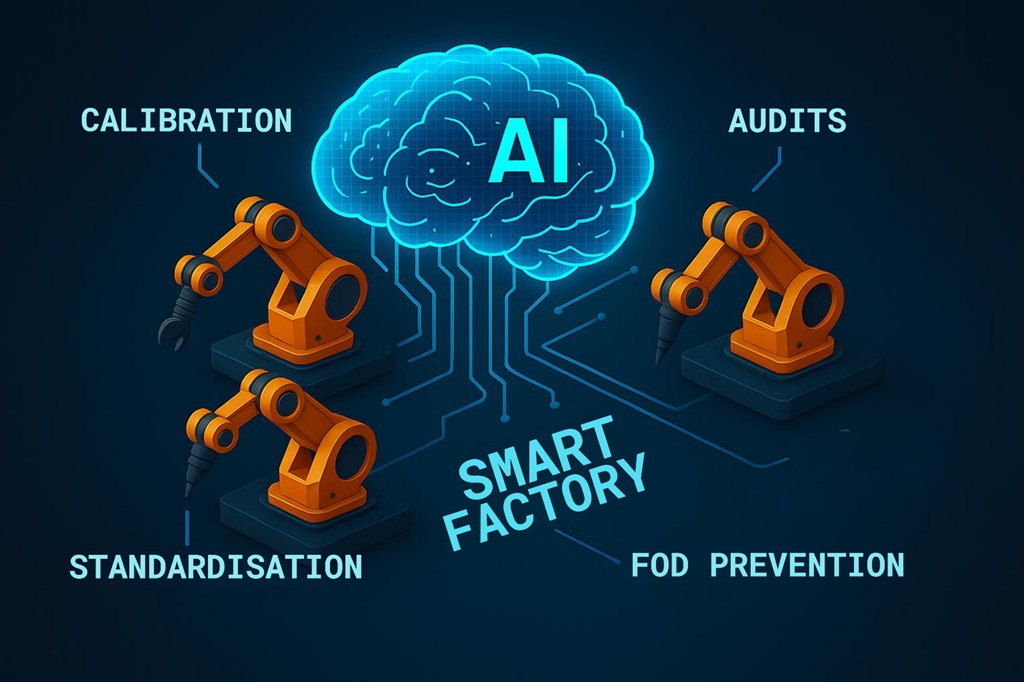
The “limbs” of the smart factory

As we move toward “autonomous, smart operations” where AI acts as the plant’s brain, your tools are the limbs. If those limbs are uncalibrated or unorganised, the most advanced AI in the world cannot guarantee safety or efficiency.

If your tools are not correctly looked after, then the robots and machinery they service and maintain or the products they build will suffer and the knock-on effects can be severe and costly.

With 35% of food safety non-conformances already linked to maintenance and calibration gaps, the message for 2026 is clear: Resilience isn’t built in the boardroom; it’s built at the tool level.

https://thisiskit.com/wp-content/uploads/2026/05/smartfactory.jpg 512 1024 Mark Pedrasa https://thisiskit.com/wp-content/uploads/2026/02/kit-logo.png Mark Pedrasa2026-05-06 10:24:502026-05-22 11:44:42The DNA of resilience

Digital twins in Industry 4.0

December 16, 2025/in Blog, ExploreKit, Tool Calibration/by coplan

How KIT is powering the future of smart manufacturing

Industry 4.0 and digital twins

In the era of Industry 4.0, digital twins are no longer a futuristic concept. They’re a practical, powerful tool reshaping how manufacturers design, monitor, and optimise operations. At KIT, we’re proud to help businesses bridge the physical and digital worlds with precision, control, and clarity.

What is a digital twin?

A digital twin is a virtual replica of a physical asset, system, or process or entire manufacturing site. It uses real-time data and simulation models to mirror the behaviour and performance of its physical counterpart.

In manufacturing, this means you can visualise, analyse, and optimise everything from individual tools to entire production lines, without ever touching the shop floor.

Why digital twins matter in Industry 4.0?

Industry 4.0 is all about connectivity, automation, and data-driven decision-making. Digital twins are central to this vision because they enable:

  • Predictive maintenance – Spot issues before they cause downtime.
  • Process optimisation – Simulate changes and improvements virtually.
  • Enhanced quality control – Monitor tool wear, calibration status, and usage patterns.
  • Faster onboarding and training – Use digital models to train staff without interrupting operations.

How KIT supports digital twin technology?

At KIT, we provide the foundation for digital twins by digitising and organising your physical assets, starting with your tools and equipment. Here’s how:

1. 2D Profiling & visual audits

We create accurate 2D profiles of your tools and equipment, forming the visual basis of your digital twin. These profiles are used to design custom foam inserts that transform tool drawers from chaos to order.

When these layouts are digitised in KIT, your entire tool inventory becomes catalogued, searchable, and visually represented. Tool audits become quick and simple, saving time and improving readiness for every shift.

2. Real-time inventory & calibration data

KIT tracks tool location, availability, condition, and calibration history. This live data feeds into your digital twin, ensuring it reflects the current state of your environment.

Planning a factory floor remodel, production ramp-up, or new project? Your digital twin lets you model and measure effectiveness before making changes.

KIT also automates calibration management and shares real-time status, removing uncertainty about tool readiness and improving safety and compliance.

3. Custom foam inserts & visual control

Custom foam inserts provide the first step toward organisation. When mirrored in KIT’s digital environment, they give teams ownership and accountability.

If tools go missing or break, reporting is instant, there’s no more end-of-shift surprises. Team members can log the issues immediately and this is flagged up in KIT’s dashboard. Managers can act quickly to order replacements, prioritise repairs, or reallocate resources to keep production moving.

4. Driving 5S and integration

KIT supports 5S principles: Sort, Set in Order, Shine, Standardise & Sustain. KIT drives workplace organisation by reducing clutter, freeing space, promoting pride and ownership and standardising tool management.

Integration with ERP systems and reporting tools like Power BI makes KIT a key enabler of smart factory analytics. KIT drives 5S practice forward, removing uncertainty and empowering teams to take control of their environments with pride.

The future: from digital twins to autonomous operations

We’re exploring IoT sensors, machine learning, self-serve onboarding and predictive analytics to make digital twins even smarter. Our goal? For KIT to help manufacturers not just see their operations but understand and improve them in real time.

Ready to build your digital twin?

Whether you’re just starting your Industry 4.0 journey or looking to enhance your existing systems, KIT is here to help.

https://thisiskit.com/wp-content/uploads/2025/12/industry40.jpg 439 1200 coplan https://thisiskit.com/wp-content/uploads/2026/02/kit-logo.png coplan2025-12-16 14:23:042026-05-22 07:45:53Digital twins in Industry 4.0

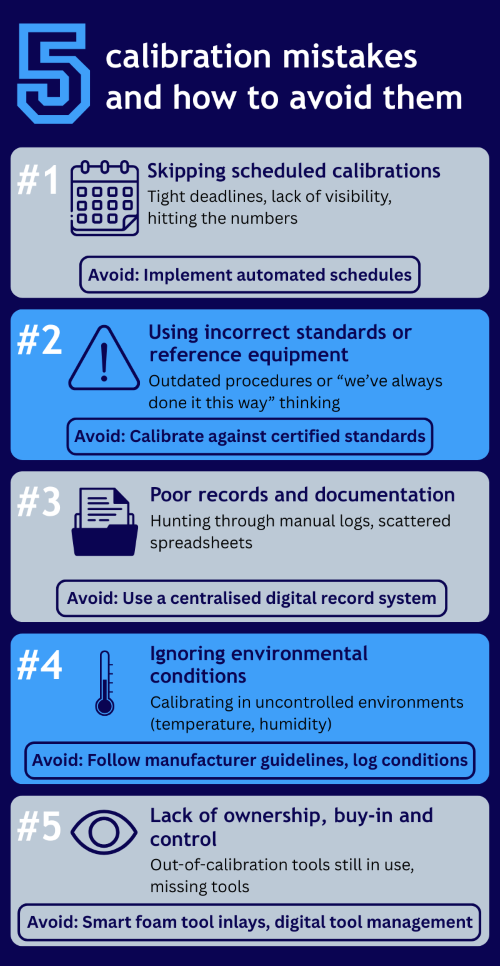
5 common calibration mistakes and how to unlock peak performance

November 18, 2025/in Blog, Professional Services & Training, Tool Calibration/by coplan

Effective tool calibration is as much about confidence and piece of mind as compliance

Why worry about tool calibration?

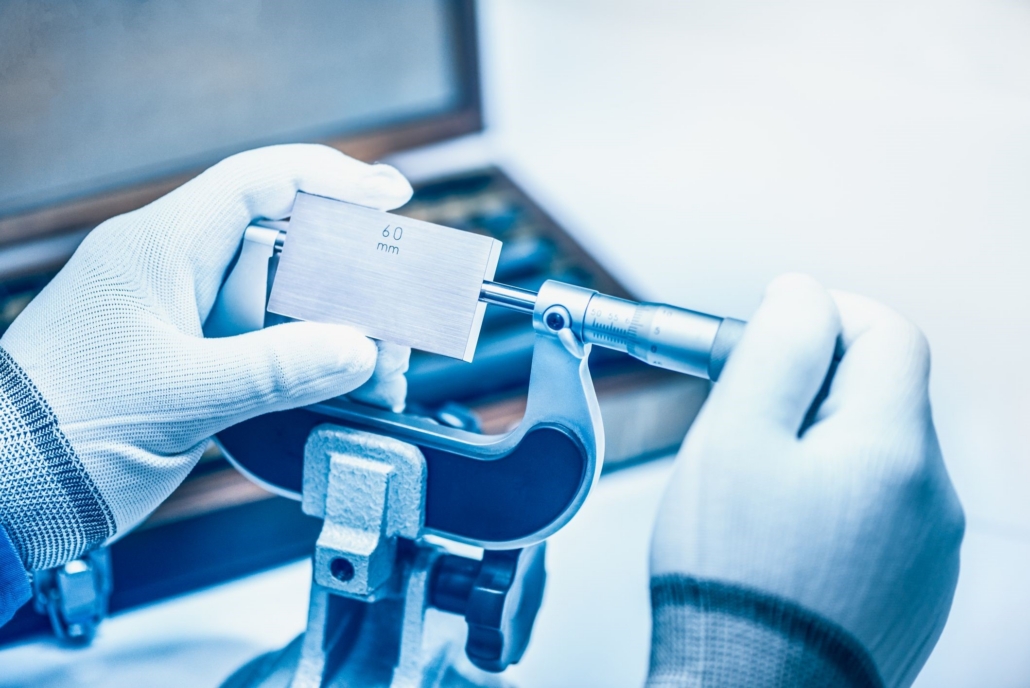
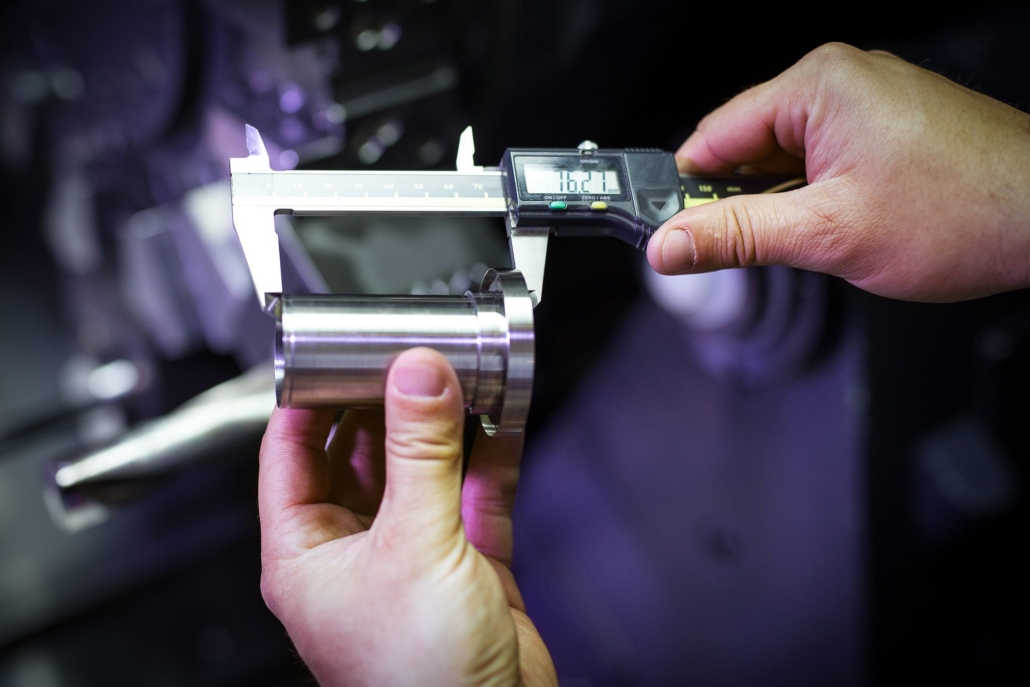
In manufacturing, tool calibration isn’t just a compliance checkbox to be ticked just before your audits are due, it’s a major factor in preventing unplanned downtime, optimising productivity and ensuring product quality.

With downtime costing many thousands of pounds per hour, no organisation can afford such interruptions, especially when they’re preventable. Even experienced teams can benefit from fine-tuning their calibration approach to save time, reduce costs, and strengthen reputation.

This blog covers the five most common calibration mistakes in manufacturing, their impact and how to avoid them. For a deeper dive of some of the other common calibration mistakes, read this article published in AutomationForum.co.

Mistake 1: Skipping scheduled calibrations

Whether it’s the pressure of tight deadlines, a drive to hit the numbers, cost-saving attempts or just down to a lack of visibility, skipping calibrations always costs more in the long-run.

Whether it results in increased measurement errors, equipment malfunction or breakdown, product rework or quality issues, safety incidents or failed audits, they all hurt the organisation. Whereas staying on schedule ensures accuracy, reliability, and long-term savings.

Avoiding it can be simple. Implement automated schedules, which send out early and overdue reminders and increase their visibility via dashboards that are shared across the management team, so that nothing is left to chance.

Mistake 2: Using incorrect standards or reference equipment

Whilst staff turnover and training can certainly be a factor in not adhering to correct calibration standards, it’s more often due to lack of a clearly documented procedure and nominated test equipment and referring to outdated standards.

By not keeping up with the latest standards or equipment, tools can often seem like they are giving the right results, only to later find that the results were inaccurate and tools were out of tolerance. In severe circumstances, this can lead non-compliances, fines, product defects and other reputational damage.

Updating processes ensures your team benefits from the latest standards and best practices and with a clear calibration policy outlining measurements, expected results and nominated test equipment, there can be no confusion.


Mistake 3: Poor records and documentation

Relying on manual logs and practices that can be traced back decades is still commonplace. Logs filed away somewhere in old lever arch files, held on clipboards scattered around the shop floor or even on various spreadsheets stored on different servers do not create the right impression on an auditor who wants to see records that are complete, legible and controlled.

This can cost the organisation dearly, with audit failures and inability to prove compliance leading to sanctions, fines or a complete cessation of production until practices are changed and shown to be under control.

Avoiding this needn’t be scary. Digital records not only make calibrations easier to manage, they also make audits smoother and showcase your commitment to quality.

Mistake 4: Ignoring environmental conditions

When calibrating tools, environment conditions such as temperature, humidity and air quality can impact the consistency and accuracy of your calibration test results just as much as dirt, wear or damage on the tool or the test equipment.

Avoiding this is usually means observing the manufacturer’s guidelines and logging the test conditions under which the calibrations took place. On highly specialist or sensitive equipment, controlled conditions protect your tools and ensure consistent, accurate results. Engaging external calibration services who live and breathe these ultra-controlled conditions is often the most cost-efficient way to guarantee the validity of the calibration..

Always ensure that regardless of whether conducted internally or externally, environmental conditions are captured as part of the calibration record in case you need to rule out such factors in any root cause analysis for any failures.

Mistake 5: Lack of ownership, buy-in and control

Ownership of key tasks like tool calibration is sometimes de-prioritised when in a pinch. But as stated earlier, it is a mistake that is likely to lead to errors in production or safety hazards that slow down or even halt production. Instead, empowering teams, as detailed in our earlier blog on “7 ways to ease the pain of calibration”, with clear ownership builds confidence and pride in quality and all but eliminates these avoidable issues.

Equally, visual tool control solutions like foam inlays in tool cabinets and shadowboards twinned with digital tool management solutions ensure that tools don’t get mixed up or lost between shifts or lines and out-of-calibration tools are taken out of use thus avoiding costly usage errors. This investment gives teams confidence that they can trust their tools, and invokes an added sense of pride, care and ownership in wanting to look after their tools properly.

Conclusion

Avoiding these mistakes and adopting best practices isn’t just about compliance, it’s about confidence in every measurement. And it can be a lot easier than it seems.

Recently awarded Calibration Product of the Year, KIT makes calibration management simple, visual, and audit-ready.

Here’s how KIT helps avoid these pitfalls:

  1. Automated scheduling with reminders and dashboards for visibility.
  2. User-defined digital calibration policies aligned with ISO and manufacturer standards.
  3. Centralised records for calibration and audit histories.
  4. Environmental data logging and certificate storage.
  5. Visual control systems and a digital twin that promote ownership, accountability and pride.


https://thisiskit.com/wp-content/uploads/2025/11/callipers.jpg 675 1200 coplan https://thisiskit.com/wp-content/uploads/2026/02/kit-logo.png coplan2025-11-18 13:41:402026-05-22 11:21:535 common calibration mistakes and how to unlock peak performance

Why calibration schedules matter

November 3, 2025/in Blog, Tool Calibration/by coplan

Achieve operational excellence with automated calibration schedules that make sense for your team.

How big a challenge is calibration anyway?

In industries where precision is non-negotiable, such as manufacturing, aerospace, automotive, healthcare, and energy, calibration schedules are essential to maintaining the accuracy, reliability, and compliance of measurement instruments.

This article explores what calibration schedules are, why they’re important, and how KIT helps organisations manage them efficiently.

What tools are we talking about?

In today’s engineering and mass production world, the sheer volume and variety of tools and equipment requiring regular calibration can be overwhelming, especially when tracked manually. Regular calibration is vital to keep them working accurately and reliably to minimise downtime and delay.

Tools such as:

  1. Mechanical tools: Micrometers, calipers, torque wrenches, crimping tools
  2. Electrical tools: Multimeters, torque drivers, electrical testers
  3. Environmental & lab equipment: Thermometers, balances and scales, spectrometers, environmental chambers
  4. Force & pressure instruments: Load cells, pressure gauges, hardness testers

And that’s just for starters. But managing all these tools manually is a major challenge.

Despite its importance, calibration often falls to the bottom of the priority list, seen as tedious and time-consuming. Motivating a team to take it seriously can also be a challenge, but is eminently doable, as we highlighted in our earlier blog “7 ways to ease the pain of calibration”.

Conversely, the consequences both immediately and longer-term of skipping calibrations can be significant. as International Process Solutions, Inc identified in their excellent blog on The Role of Calibration in Precision and Compliance.

The easiest way to ensure calibrations aren’t missed is to determine a calibration schedule that works for the needs of your business.

What is a calibration schedule?

A calibration schedule is a structured timing plan that defines when and how often equipment or instruments should be calibrated to ensure they continue to perform within specified tolerances. These schedules are typically based on:

  • Manufacturer recommendations
  • Industry standards (e.g., ISO 9001, ISO/IEC 17025)
  • Historical performance data
  • Risk assessments and criticality of the instrument
  • Specific usage patterns of the organisation
  • Timing of key projects or production runs

There are no absolutes here about how often you should calibrate and it is about finding what works for your organisation and keeps you compliant with the regulations of your particular industry.

Why calibration schedules are important

Accuracy and reliability

Regular calibration ensures instruments provide accurate measurements, which is vital for quality control, safety, and operational decision-making. The knock-on effects of poorly calibrated instruments and tools is well documented in some of the earlier blog links, but the effect on trust, perceptions and relationships internally cannot be underestimated. No-one wants to be seen as the shabby and ineffective part of the organisation or have their work questioned at every turn. Showing that you have accuracy and reliability nailed breeds trust and respect.

Compliance and auditing

Many industries are governed by strict regulations. A documented calibration schedule helps meet compliance requirements and prepares organisations for audits. A schedule backed by evidence of calibrations being performed on a regular basis makes the difference between sailing through audits and having non-conformance black marks and makes for uncomfortable moments with the auditors and the rest of the management team.

Preventive maintenance

Calibration schedules can reveal drift trends or early signs of equipment failure, enabling proactive maintenance and reducing downtime. Improving uptime and yield metrics through being proactive and repairing, replacing or servicing equipment before it affects productivity shows a team with discipline and a team that can be relied on to get the job done right.

Cost efficiency

While calibration does come with a cost, the potential impact of unplanned failures or product recalls due to inaccurate measurements can be significantly greater. Sometimes, issues can arise from raw components or sub-assemblies, and without thorough inspection and testing, these can be difficult to detect. The good news is that your tools are within your control. Mistakes are understandable, but if patterns of tool neglect emerge, they can be more challenging to justify. Proactive maintenance and calibration help ensure reliability and reduce risk.

How KIT supports calibration schedule management

KIT is a tool and equipment inventory management platform designed to simplify and automate equipment lifecycle management, including calibration workflows. Here’s how KIT enhances calibration scheduling:

Automated scheduling & notifications

KIT allows users to set custom calibration policies and schedules for each asset. The system automatically generates reminders and alerts for upcoming or overdue calibrations, reducing the risk of missed events. KIT’s dashboard highlights upcoming, overdue and failed calibrations, giving actionable insight to managers from which they can determine their next steps to keep things under control before they become an issue.

Digital calibration records

Every calibration event is logged with date, technician, policy, individual test results and outcome, including generation of a calibration certificate, creating a traceable audit trail over time. These records are accessible in real-time and exportable for compliance reporting.

Calibration history & trend analysis

KIT tracks calibration performance over time by maintaining records of all calibrations, helping users identify instruments that frequently drift or require more frequent attention. This supports risk-based scheduling and smarter resource allocation or decisions about whether to switch to alternative tooling that may be more suitable to your environment and needs.

Integration with inventory & audit modules

Calibration schedules are linked directly to KIT’s inventory and visual audit tools, ensuring that calibration status is visible during inspections and asset reviews. Being able to demonstrate that you have comprehensive records for each of your tools is not difficult, but can be a real game-changer with auditors.

Support for complex, multi-site operations

For organisations with multiple facilities, KIT enables centralised calibration management across locations, with scheduling and reporting that can be customised to be site or project specific. Being able to set expectations for each project or site rather than have to abide by schedules that simply don’t make sense for that team or site, means adherence and compliance is working for you rather than against you and is more likely to find support in the teams responsible for the work.

Conclusion

Calibration schedules are critical for ensuring measurement accuracy, regulatory compliance, and operational efficiency. With KIT, organisations can shift from manual tracking to automated, intelligent calibration management, reducing risk, boosting performance, and turning calibration from a dreaded task to the backbone of trust and reliability across operations.

https://thisiskit.com/wp-content/uploads/2026/03/41.jpg 1415 2119 coplan https://thisiskit.com/wp-content/uploads/2026/02/kit-logo.png coplan2025-11-03 16:08:122026-05-22 11:23:22Why calibration schedules matter

What to look for in a tool calibration system provider

October 17, 2025/in Blog, ExploreKit, Professional Services & Training, Tool Calibration/by coplan

Choosing the right provider is as much about finding the right partner as the technology.

What to look for in choosing a tool calibration system

When it comes to tool calibration, accuracy is key. Whether you’re in manufacturing, engineering, or quality assurance, the tools you rely on need to be consistently calibrated to avoid errors, downtime, and compliance issues.

But choosing the right calibration system provider can be tricky. It’s not just about features, it’s about finding a solution and a partner that fits how your team works and grows with your needs. Here’s what to look for when evaluating your options.

1. Flexibility in calibration policies

Every organisation has its own standards and workflows. A good calibration system should let you define tool-specific policies that reflect your internal requirements that can change with you, not force you into rigid templates.

KIT, for example, allows users to configure calibration policies per tool, helping teams eliminate ambiguity and ensure every check is done right. This flexibility is especially useful in environments with mixed toolsets or varying compliance needs.

2. Clear audit trails and compliance support

Traceability is key. Look for systems that automatically log calibration events, flag overdue checks, and generate certificates. This makes it easier to stay compliant with standards like ISO 9001 or ISO 45001, and to prove it during audits.

KIT’s clickable calibration histories and automated certificate generation help teams maintain a clear record without the paper chase.

3. Ease of use for technicians and admins

If the system isn’t intuitive, it won’t get used properly. Choose a provider that prioritises user experience with clean interfaces, mobile access, and workflows that make sense for both technicians and managers.

One KIT customer in the aerospace sector shared this:

“KIT gives us complete control over our tool calibration. It’s so simple to use, yet audit-proof, scalable, and built for the complexity of aerospace. “

4. Data centralisation and integration

Tool calibration doesn’t happen in isolation. Your system should align or integrate with asset management, audit, reporting and ERP/procurement platforms to reduce manual data entry and keep everything in sync where relevant.

One-stop solutions like KIT create a place for everything and everything in one place, giving you confidence that your tool data needs are covered.

5. Scalability and support

Think beyond today. Can the system grow with your team? Does the provider offer onboarding help, responsive support, and regular updates? These are crucial when rolling out across multiple sites or departments.

6. Data visibility and reporting

You should be able to see what’s calibrated, what’s due, and what’s out of spec without digging through spreadsheets. Dashboards, alerts, and exportable reports should give you the answers you need to help you stay proactive.

7. Offline and remote capabilities

If your tools are used in the field or in areas with limited connectivity, offline functionality is a must. The system should sync seamlessly when back online, without risking data loss. Equally, if you are operating across a large site with multiple buildings or across multiple locations, the flexibility of being able to access and record data on the move is key.

But don’t just look at the software in isolation as this is more than just a procurement problem, look at the provider too.

Beyond the software: What makes a great calibration system partner

Choosing a calibration system is also about choosing the right people to work with. A true partner brings more than just technology. They bring insight, support, and a shared commitment to your success.

Here’s what to look for in the provider themselves:

1. Responsive, human support

AI agents and chatbots are great when you have a generic question or challenge, but when something goes wrong and you just need a quick answer, you don’t have time to be asking lots of questions of a chatbot and getting caught in a relentless loop. You need answers.

Ready access to a knowledgeable, responsive support team makes all the difference. Look for providers who treat support as a relationship, not a ticketing system and those who invest the time up front to helping your team onboard and embed the solution properly to minimise challenges later down the line.

2. Willingness to challenge and improve

A good partner doesn’t just say “yes”, they ask “why.” They will draw on their knowledge and experience of working with other customers with similar challenges and act as a critical friend, helping customers refine their processes, spot inefficiencies, and challenge assumptions when needed.

3. Industry understanding

Providers who understand your sector can offer more relevant advice and anticipate challenges. Specialist partners can be useful in regulated industries, though they can get stuck in the “we’ve always done it this way” loop.

Partners with a breadth of experience across multiple sectors can often be more open to other ideas, challenging the norm and help customers tailor pragmatic solutions that work in the real world.

It’s about working with people who get your challenges and can come up with simple solutions.

4. Commitment to continuous improvement

The best partners don’t stand still. They will invest in continual evolution of their platform based on customer feedback and emerging technology and industry trends, adding features that solve real problems and improve workflows.

5. Transparent communication

Whether it’s roadmap updates, pricing changes, or feature limitations, transparency builds trust. An open approach to communication helps customers plan confidently and avoid surprises.

Equally, if partners are constantly over-promising and under-delivering, or not being realistic and honest, then they are not a true partner.

Final thoughts

The right calibration system doesn’t just help you stay compliant, it helps you build trust in your tools, your team, and your data.

More importantly, the right system partner does more than offer responsive support. They are also willing to challenge assumptions, offer honest feedback, be honest about issues or concerns and provide alternatives to help you improve. They genuinely care and want to help you succeed and stay ahead of the curve…not just sell to you and move on.

At KIT, we don’t just offer software, we aim to be a true and trusted partner. We’re here to help you get it right, not just get it done.

https://thisiskit.com/wp-content/uploads/2026/03/s3.jpg 430 602 coplan https://thisiskit.com/wp-content/uploads/2026/02/kit-logo.png coplan2025-10-17 16:01:492026-05-21 16:16:50What to look for in a tool calibration system provider

7 ways to ease the pain of calibration

October 2, 2025/in Blog, Professional Services & Training, Tool Calibration/by coplan

At the centre of making tool calibration work in your organisation is having clear buy-in from the people it affects and who are responsible for its delivery.

Making calibration positive

Here are 7 people-focused strategies to make calibration feel less like a chore and more like a valued part of the job:

1. Connect calibration to purpose

Help people see the “why” behind calibration, it’s not just about compliance, but safety, quality, reputation and pride in craftsmanship. When people understand the impact of accurate tools on real-world outcomes, motivation increases.

2. Celebrate the role

Recognise and appreciate those who consistently perform calibrations well. Whether it’s a shout-out in a team meeting or a small reward, showing that their effort matters can shift attitudes from “burden” to “contribution.”

3. Make it social

Pair people up or rotate calibration duties as a team activity. This can:

  • Break monotony
  • Encourage knowledge sharing
  • Build camaraderie

Turning it into a shared task makes it feel less isolating.

4. Reduce friction

If the process is clunky or vague, people will dread it. Ask for feedback and streamline the workflow:

  • Clear instructions
  • Easy access to tools
  • Logical layout of calibration stations

Removing small annoyances can make a big difference in attitude.


5. Build confidence

Sometimes frustration stems from uncertainty. Offer hands-on training and cheat sheets so people feel capable and confident. When they know what they’re doing, they’re more likely to do it willingly.

6. Give ownership

Let people take charge of their own calibration schedules or stations. Autonomy fosters responsibility and pride. When it’s their tools and their process, it’s no longer just a task, it’s an integral part of their role.

7. Make it visible

Use dashboards or visual trackers to show calibration status. Seeing progress and knowing they’re contributing to a bigger picture can be motivating. It also helps avoid last-minute rushes that cause stress.

Team calibration engagement plan

How do you make this change? Here’s a team calibration engagement plan designed to shift calibration from a frustrating obligation to a valued and even motivating part of the team’s workflow. This plan focuses on human engagement, ownership, and culture.

Objective

To foster a positive, proactive attitude toward calibration tasks by improving team engagement, ownership, and understanding of their importance.

1. Kickoff: reframe the narrative

Action: Host a short team session to explain:

  • Why calibration matters (quality, safety, pride)
  • How it impacts the team’s success
  • What frustrations exist and how they’ll be addressed

Goal: Build shared understanding and buy-in.

2. Assign calibration champions

Action: Nominate or rotate team members as “Calibration Champions” who:

  • Help others with calibration
  • Track progress
  • Share tips and improvements

Goal: Create peer leadership and reduce reliance on management.

3. Visual progress tracker

Action: Set up a wallboard or digital dashboard showing:

  • Calibration status by tool or station
  • Who completed what
  • Upcoming deadlines

Goal: Make progress visible and encourage accountability.

4. Recognition & rewards

Action: Celebrate calibration efforts monthly:

  • “Most Consistent Calibrator”
  • “Fastest Accurate Calibration”
  • “Best Calibration Station Setup”

Goal: Reinforce positive behaviour and make it fun.

5. Feedback loop

Action: Create a simple way for team members to share:

  • What’s frustrating
  • What’s working
  • Suggestions for improvement

Goal: Empower the team to shape the process.

6. Training & confidence building

Action: Offer short, hands-on refreshers or cheat sheets:

  • Clear steps for each tool
  • Common mistakes to avoid
  • Who to ask for help

Goal: Reduce hesitation and build confidence.

7. Calibration culture moments

Action: Integrate calibration into team rituals:

  • Quick calibration check-in during stand-ups
  • “Calibration Tip of the Week”
  • Share stories of how calibration prevented issues

Goal: Normalise and embed calibration into daily work life.

Optional add-ons

  • Gamify it: Use points or badges for completed calibrations.
  • Team challenges: “Calibrate all tools by Friday” with a reward.
  • Mini makeovers: Let teams redesign their calibration stations for ease and pride.

Summary

If a team doesn’t follow a well thought out calibration engagement plan, especially one focused on the human side, the consequences can ripple through both the business and the team culture. It’s well documented how poor calibration practices can open the door to quality issues, compliance risks, increased costs and reputational damage.

It’s perhaps less clear the impact it can have on the team. Neglecting the human side of calibration doesn’t just affect tools, it affects trust, teamwork, and performance and can lead to frustration and burnout, blame culture, skills gaps and disconnection from purpose. A strong engagement plan helps build a culture where calibration is respected, understood, and done well.

So much of this can be avoided by having a simple automated system such as KIT that enables consistency, empowers individuals and provides visibility to drive ownership and engagement.

https://thisiskit.com/wp-content/uploads/2026/03/7-ways-calibration.jpg 1280 1920 coplan https://thisiskit.com/wp-content/uploads/2026/02/kit-logo.png coplan2025-10-02 14:14:242026-05-22 11:41:207 ways to ease the pain of calibration

10 tips for developing effective calibration practices

September 15, 2025/in Blog, ExploreKit, Professional Services & Training, Tool Calibration/by coplan

Tool calibration is critical to precision and control in engineering and manufacture, yet it is so often overlooked or avoided.

Calibrating tools sounds straightforward; just follow a process, take some measurements and adjust where necessary to stay within tolerance and record the results.

But people often sidestep it for a mix of practical and psychological reasons. Here’s why:

  • Time constraints: Calibration can be time-consuming without good systems, especially in busy work environments where speed is prized over precision.
  • Overconfidence in accuracy: If a tool seems to be working “well enough,” people assume it’s still accurate, even if it’s drifted over time.
  • Lack of awareness or training: Not everyone knows how or why calibration matters, especially for newer or non-technical users.
  • Inconvenience: Some tools need special equipment or need to be sent off-site to be calibrated, which disrupts workflows.
  • Cost factors: Calibration services or buying the right reference standards can be expensive, especially for smaller operations.
  • Perceived low risk: In contexts where extreme precision isn’t necessary, people might skip calibration, figuring the consequences are minor.

Here’s why it matters:

  • Reliable results: Regular calibration ensures tools perform as expected and avoid costly mistakes or safety risks.
  • Regulatory compliance: Industries like healthcare, aerospace, and manufacturing often require calibration to meet legal standards.
  • Trust & reputation: A mis-calibrated tool can undermine results and damage professional credibility.

People often prioritise speed over certainty, until something goes wrong.

So how do you counter this and tighten up your calibration practices?

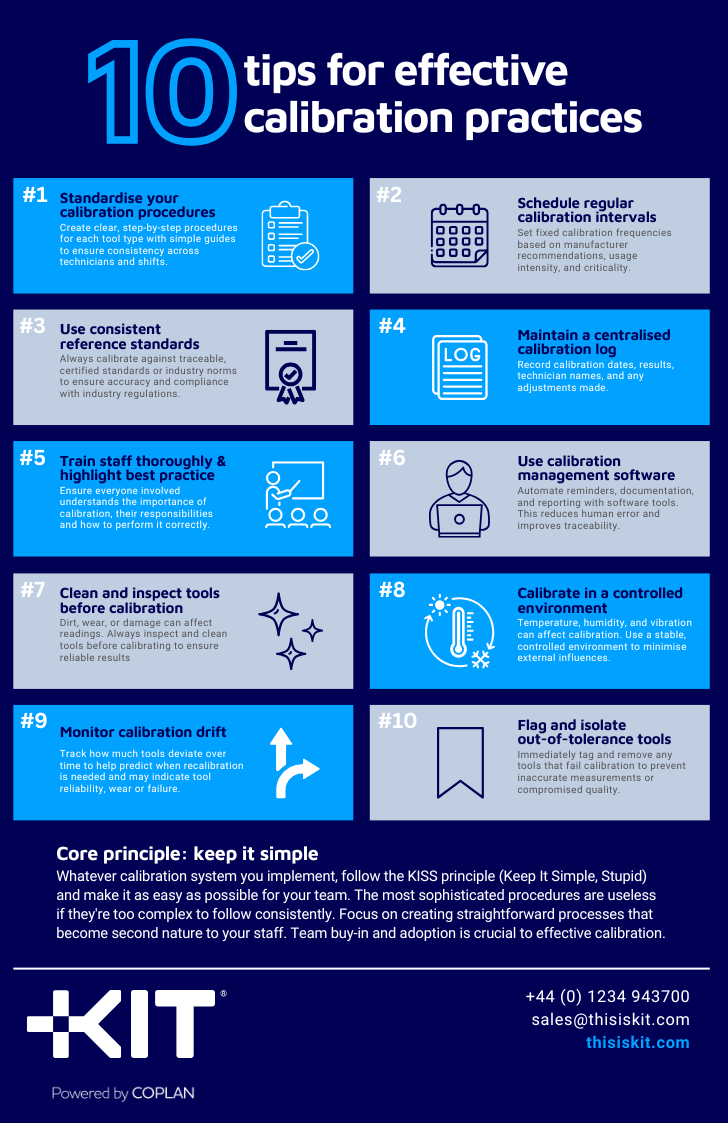
Here’s 10 practical tips for making effective calibration a reality:

1. Standardise your calibration procedures

Create clear, step-by-step procedures for each tool type. Use checklists or simple guides to ensure consistency across technicians and shifts.

2. Schedule regular calibration intervals

Set fixed calibration frequencies based on manufacturer recommendations, usage intensity, and criticality. Use calendar reminders or software to automate scheduling.

3. Use consistent reference standards

Always calibrate against traceable, certified standards or industry norms to ensure accuracy and compliance with industry regulations. Being consistent with your approach to calibration of tools over time simplifies compliance and makes it less painful for the technicians doing the calibrations.

4. Maintain a centralised calibration log

Record calibration dates, results, technician names, and any adjustments made. Digital calibration management systems are ideal for easy access and audits and give that confidence that checks are being done and issues captured.

5. Train staff thoroughly and highlight best practice

Ensure everyone involved understands the importance of calibration, their responsibilities and how to perform it correctly. Include calibration in onboarding and refresher training and celebrate good practice within the team.

6. Use calibration management software

Automate reminders, documentation, and reporting with software tools. This reduces human error and improves traceability.

7. Clean and inspect tools before calibration

Dirt, wear, or damage can affect readings. Always inspect and clean tools before calibrating to ensure reliable results.

8. Calibrate in a controlled environment

Temperature, humidity, and vibration can affect calibration. Use a stable, controlled environment to minimise external influences.

9. Monitor calibration drift

Track how much tools deviate over time. This helps predict when recalibration is needed and may indicate tool reliability, wear or failure. Centralising the calibration history of your tools gives you that at a glance knowledge of potential problems.

10. Flag and isolate out-of-tolerance tools

Immediately tag and remove any tools that fail calibration to prevent inaccurate measurements or compromised quality. Respond early to flagged and recurring issues to reinforce importance. Engage team in refining procedures and tool design or selection / testing of alternatives.

Calibrating tools and instruments doesn’t have to be a tedious chore. By blending smart automation, streamlined workflows, and clear accountability, you can turn calibration from a dreaded task into a seamless part of your routine. But whatever you do, use the KISS principle and make it as easy as possible as team buy-in and adoption is so crucial to effective calibration.

https://thisiskit.com/wp-content/uploads/2026/03/10-tips-calibration.jpg 1280 1920 coplan https://thisiskit.com/wp-content/uploads/2026/02/kit-logo.png coplan2025-09-15 14:17:582026-05-28 13:18:5210 tips for developing effective calibration practices

Overcoming calibration chaos

March 20, 2025/in Blog, Tool Calibration/by coplan

In any organisation where precision and accuracy are paramount, keeping tooling and equipment calibrated and tested is critical.

Yet, for Quality and Metrology managers, the process of gathering these tools for calibration often feels like herding cats.

Colleagues might overlook prompts and reminders, and relying on spreadsheets can make the entire process feel reactive and cumbersome. However, there are strategies that can ease this burden, such as systems that automate effective email prompts and reminders—provided the responsibility doesn’t solely fall on the Quality and Metrology departments—along with implementing 5S and Visual Management solutions.

The challenges of gathering tools for calibration

One of the most frustrating aspects of managing calibration schedules is the tendency for prompts and reminders to go unnoticed or unheeded. Whether it’s an email, a message on a collaboration platform, or even a physical reminder in the workspace, these notifications often fail to catch the attention they require. The reasons for this are many:

  • Email Overload: Inboxes are inundated with messages, and calibration reminders can easily get lost amidst more urgent or seemingly important communications. More notably, notifications are often not regular enough to prompt action, as it typically falls on a manual process to send and await a reply or action.
  • Lack of Immediate Relevance: For many employees, calibration doesn’t seem immediately relevant to their daily tasks, leading to deferment.
  • Cognitive Overload: Employees juggling multiple responsibilities might not prioritise calibration tasks, especially if they don’t see immediate consequences for delays.

Reactive spreadsheet management

Spreadsheets are a common tool for tracking calibration schedules, but they often lead to a reactive rather than proactive approach:

  • Outdated Information: Spreadsheets require constant updating, and it’s easy for data to become outdated, leading to missed calibration dates.
  • Lack of Real-Time Visibility: Spreadsheets don’t provide real-time visibility of tool locations and statuses, making it hard to quickly identify and retrieve items due for calibration.
  • Manual Errors: The manual nature of spreadsheet management introduces a higher risk of errors, which can complicate the calibration process further.

“Real-time visibility of tool statuses and locations allows for more proactive management, reducing the reactive nature of the process.”

https://thisiskit.com/wp-content/uploads/2026/03/c1.jpg 783 994 coplan https://thisiskit.com/wp-content/uploads/2026/02/kit-logo.png coplan2025-03-20 15:42:532026-05-21 15:53:15Overcoming calibration chaos

When 5S isn’t 5S, it’s only 3S

February 21, 2025/in Blog, Tool Standardisation/by coplan

How KIT helps organisations achieve full 5S

The 5S methodology is a cornerstone of workplace organisation, focusing on Sort, Set in Order, Shine, Standardise, and Sustain. While many organisations excel at the first three steps, they often fall short on the final two. Without proper standardisation and sustainability, the benefits of 5S are fleeting.

Enter KIT, a transformative system that leverages QR codes and a centralised database to ensure organisations don’t just reach 5S, but maintain it for the long term. KIT bridges the gap between 3S and 5S, making true workplace efficiency and consistency achievable.

Why do organisations get stuck at 3S?

It’s common for organisations to start strong with 5S, achieving tidy and organised workspaces. However, many struggle to move beyond the first three steps. Let’s explore why:

1. Missing tools lead to delays

Tools often go missing due to lack of tracking, creating inefficiencies. Employees spend valuable time searching for items, disrupting workflows.

2. Inconsistent tool replacements cause disorder

When tools are damaged or lost, replacements are frequently purchased without adherence to standards. This results in mismatched tools that disrupt the system.

3. No documented processes to maintain standards

Without clear procedures for tool management, teams often revert to old habits. This lack of standardisation means the workspace becomes disorganised again over time.

These common issues illustrate why Sort, Set in Order, and Shine are not enough to achieve lasting results.

How KIT bridges the gap between 3S and 5S

KIT transforms how organisations manage their tools and workspaces, addressing the critical gaps in Standardise and Sustain. Here’s how it works:

1. QR codes for efficient tool tracking

Every tool in your workspace is assigned a unique QR code linked to KIT’s centralised database. This system provides:

  • Instant Location Tracking: Employees can scan QR codes to locate tools or report missing items.
  • Accountability Across Teams: Usage can be monitored to ensure tools are returned to their proper place.
  • Streamlined Audits: Routine checks become faster and more accurate with a simple scan.

2. A centralised database for standardisation

KIT’s database acts as the foundation for consistent tool management. It includes:

  • A full inventory of all tools, their specifications, and maintenance requirements.
  • Clear guidelines for ordering replacements, ensuring that new tools match the originals.
  • Documentation of standard operating procedures, accessible to all employees.

3. Automated processes for sustainability

Sustainability requires ongoing effort, and KIT makes it easy to maintain high standards. Key features include:

  • Automatic Alerts: Notifications remind teams to reorder tools or perform maintenance.
  • Regular Reports: Data insights highlight trends, such as frequently misplaced tools, enabling proactive solutions.
  • Customisable Checklists: Ensure teams follow 5S principles consistently.

“It’s common for organisations to start strong with 5S, achieving tidy and organised workspaces. However, many struggle to move beyond the first three steps.

From 3S to 5S: why KIT is the missing piece

For organisations relying on foam shadow boards or manual tracking systems, KIT provides the tools needed to reach and maintain full 5S. Here’s what sets KIT apart:

1. Solves the problem of missing tools

With QR code tracking, every tool is accounted for. Teams can quickly identify and address missing or misplaced items, reducing downtime.

2. Ensures consistency across the workspace

KIT’s centralised database eliminates inconsistencies caused by ad-hoc replacements. Every tool is standardised to fit the system, ensuring a logical and efficient setup.

3. Embeds sustainability into daily operations

KIT empowers teams to sustain 5S practices with automated reminders, reports, and an intuitive interface. This ensures 5S becomes a long-term habit, not just a temporary improvement.

KIT in action: realising the full potential of 5S

Imagine a workspace where tools are always accounted for, replacements are consistent, and teams are equipped with the data they need to improve. KIT makes this vision a reality by addressing the weaknesses in traditional 3S systems.

With KIT, you’ll experience:

  • Faster workflows with minimal downtime caused by missing tools.
  • A culture of accountability, where employees take ownership of their workspace.
  • Long-term benefits of 5S, including improved safety, efficiency, and organisation.

Achieve true 5S with KIT

If your organisation has struggled to maintain 5S or has found its efforts stalling at 3S, KIT is the solution you need. With its innovative QR code technology and centralised database, KIT bridges the gap, helping organisations move from short-term fixes to long-term success.

Take the next step toward workplace excellence. Visit thisiskit.com to learn how KIT can help your organisation achieve and sustain true 5S.

https://thisiskit.com/wp-content/uploads/2026/04/when-5s.jpg 1280 1920 coplan https://thisiskit.com/wp-content/uploads/2026/02/kit-logo.png coplan2025-02-21 10:45:182026-05-22 07:49:23When 5S isn’t 5S, it’s only 3S

Streamlining organisational efficiency with KIT

May 20, 2024/in Blog/by coplan

In today’s rapidly evolving business landscape, managing tools and equipment efficiently is crucial for any organisation aiming to maintain its competitive edge.

KIT, accessible via www.thisiskit.com, offers a promising solution to the often complicated and disjointed processes that companies face when standardising their tools and equipment. Here’s how KIT can transform your organisation’s approach to equipment management, ensuring standardisation and efficiency.

Centralised management

KIT provides a centralised platform where all tools and equipment can be managed. This centralisation eliminates the redundancy and confusion that often arises from using multiple systems. By having a single source of truth, organisations can ensure that everyone is accessing the same, up-to-date information, which is essential for maintaining standard operating procedures across the board.

Comprehensive tracking

With KIT, organisations can track the lifecycle of every piece of equipment – from acquisition to disposal. This comprehensive tracking capability allows for better forecasting and planning. It ensures that equipment is maintained, replaced, or upgraded at the right time, reducing the risk of downtime due to equipment failure.

Enhanced compliance

Standardisation is key to compliance, especially in industries that are heavily regulated. KIT helps organisations ensure that all tools and equipment meet industry standards and regulations. By managing all equipment through one platform, it’s easier to perform audits and ensure compliance, which can protect the organisation from costly fines and reputational damage.

Improved accessibility and training

KIT enhances accessibility by providing clear, structured information on each tool and piece of equipment. This can be particularly beneficial for onboarding new employees or for training purposes. With better access to information, employees can quickly learn how to use various tools correctly and safely, which enhances productivity and reduces the risk of accidents.

By standardising tools and equipment, organisations can achieve significant cost savings. KIT helps identify redundant tools and equipment, allowing companies to streamline their inventory. This not only reduces the capital tied up in unused or underused equipment but also decreases maintenance costs.

“KIT helps organisations ensure that all tools and equipment meet industry standards and regulations.

Conclusion

For any organisation looking to standardise and streamline its tools and equipment management, KIT offers a robust solution that can lead to enhanced efficiency, reduced costs, and improved compliance. By centralising data, enhancing tracking, and simplifying access to information, KIT empowers organisations to better manage their physical assets in a way that supports sustainable growth and operational excellence.

https://thisiskit.com/wp-content/uploads/2024/05/banner-kitlogin.png 900 1200 coplan https://thisiskit.com/wp-content/uploads/2026/02/kit-logo.png coplan2024-05-20 15:43:572026-05-21 16:15:47Streamlining organisational efficiency with KIT
Page 1 of 212

Pages

  • Aerospace
  • Automotive
  • Blog
  • Careers
  • Case Studies
  • Contact Us
  • Coplancontrol
  • COSHH & Safety
  • Defence
  • Events
  • Explore Kit
  • Foam Inlays (Drawers & Cases)
  • Food & Drink
  • History
  • News
  • Our Standards & Approach
  • Partners & Memberships
  • Privacy Policy
  • Professional Services
  • Protection Foams
  • Resources
  • Shadow Boards (Foam & Vinyl)
  • Terms & Conditions
  • Terms of Access
  • Terms of Use
  • Tool Audits
  • Tool Calibration
  • Tool Inventory Management
  • Tool Standardisation
  • Welcome

Categories

  • Aerospace
  • Automotive
  • Blog
  • Case Study
  • COSHH & Safety
  • Defence
  • Event
  • ExploreKit
  • Foam Inlays
  • News
  • Professional Services & Training
  • Shadow Boards
  • Tool Audits
  • Tool Calibration
  • Tool Inventory Management
  • Tool Standardisation

Archive

  • May 2026
  • April 2026
  • March 2026
  • January 2026
  • December 2025
  • November 2025
  • October 2025
  • September 2025
  • March 2025
  • February 2025
  • May 2024
  • February 2024
  • January 2024
  • November 2023
  • July 2023
  • May 2023
  • April 2023
  • March 2023
  • July 2022
  • January 2022
  • July 2021
  • May 2021

Take Your Next Step

Click a button below to move one step closer to realising how KIT can simplify your tool management

Read more about KIT Watch Demo Request Info Schedule a Call

KIT® is a registered trademark of Coplan Ltd

Location Location Coplan Ltd, 28 Vincent Avenue, Crownhill, Milton Keynes, MK8 0AB

Phone Phone +44 (0)1908 307956

Mail Mail info@coplancontrol.com

General

Home
Careers
History
Our Standards & Approach
Partners & Memberships
Resources

News & Views

Blog
Case Studies
Events
News

Products

ExploreKIT
COSHH & Safety
Tool Audits
Tool Calibration
Tool Inventory Management
Tool Standardisation
Professional Services & Training
Explore COPLAN Foams
Protection Foams
Foam Inlays
Shadow Boards

Industries

Aerospace
Automotive
Defence
Food & Drink

Contact Us

General
Book a Discovery Call

KIT® is a registered trademark of Coplan Ltd

Location Location Coplan Ltd, 28 Vincent Avenue, Crownhill, Milton Keynes, MK8 0AB

Phone Phone +44 (0)1908 307956

Mail Mail info@coplancontrol.com

General

Home
Careers
History
Our Standards & Approach
Partners & Memberships
Resources

News & Views

Blog
Case Studies
Events
News

Products

ExploreKIT
COSHH & Safety
Tool Audits
Tool Calibration
Tool Inventory Management
Tool Standardisation
Professional Services & Training
Explore COPLAN Foams
Protection Foams
Foam Inlays
Shadow Boards

Industries

Aerospace
Automotive
Defence
Food & Drink

Contact Us

General
Book a Discovery Call

©2026 KIT is a trading style of Coplan Limited
  • Link to Instagram
  • Link to LinkedIn
  • Link to Youtube
  • Terms & Conditions
  • Privacy Policy
  • Terms of Use
  • Terms of Access
Scroll to top Scroll to top Scroll to top
  • Home
  • Products
    • KIT
    • Explore KIT
    • COSHH & Safety
    • Tool Audits
    • Clear Title
    • Tool Calibration
    • Tool Inventory Management
    • Tool Standardisation
    • Other Products & Services
    • Protection Foams
    • Foam Inlays (Drawers & Cases)
    • Shadow Boards (Foam & Vinyl)
    • Professional Services & Training
  • Industries
    • Aerospace
    • Automotive
    • Defence
    • Food & Drink
  • Case Studies
  • News & Events
    • Blog
    • News
    • Events
  • About Us
    • Careers
    • History
    • Our Standards & Approach
    • Partners & Memberships
  • Contact Us