
The DNA of resilience
Why the Greencore-Bakkavor era demands tool-level discipline
The landscape of UK convenience food shifted on its axis in January 2026. With the finalised acquisition of Bakkavor, Greencore has emerged as a homegrown manufacturing titan, generating £4.1 billion in revenue and employing 28,000 colleagues across 36 locations.
But for a business now responsible for delivering 1 billion sandwiches and 400 million chilled meals every year, the greatest strategic threat isn’t just market competition, it is “standardisation drift” or “tool creep” as we sometimes call it.
The “mega-scale” standardisation challenge
Resilience at this scale is impossible if every site has its own way of managing equipment. In a multi-site network, inconsistencies in tool selection or storage lead to fragmented processes and rising costs. As Greencore pursues “delivery excellence,” the fundamental requirement is a unified standard for the physical tools that power their 3,200 products.
Whether a site is in the UK or the US, the health and organisation of its physical assets are the “DNA” of its resilience.
Circular thinking: more than just a marketing story
This shift toward tool-level discipline is further accelerated by the UK Government’s 2026 Circular Economy Growth Plan. This mandate isn’t just about recycling; it’s a structural requirement for businesses to take greater responsibility for the entire lifecycle of their products and assets.
In the factory, “circular thinking” means moving away from the “disposable tool” culture. By standardising high-quality tools and tracking them through 5S shadow boards, linked to their digital twins in software like KIT that prompts manufacturers to regularly inspect and calibrate their tools enables manufacturers to significantly extend the lifecycle of their equipment and eliminate the waste of frequent, unmanaged replacements.
The ROI of organisation
In a market defined by 5.7% food inflation and chronic labour shortages, tool loss is a “margin issue” that manufacturers can no longer ignore. Case studies show that simple organisation through shadow boards and foam inlays coupled with regular visual checks can save single facilities tens of thousands of pounds in replacement costs alone.
But the real value is in “shock absorption”. When a factory is organised, it can handle volatility, from sudden demand spikes to unexpected staff absences, without the constant firefighting caused by missing or uncalibrated equipment.
The “limbs” of the smart factory
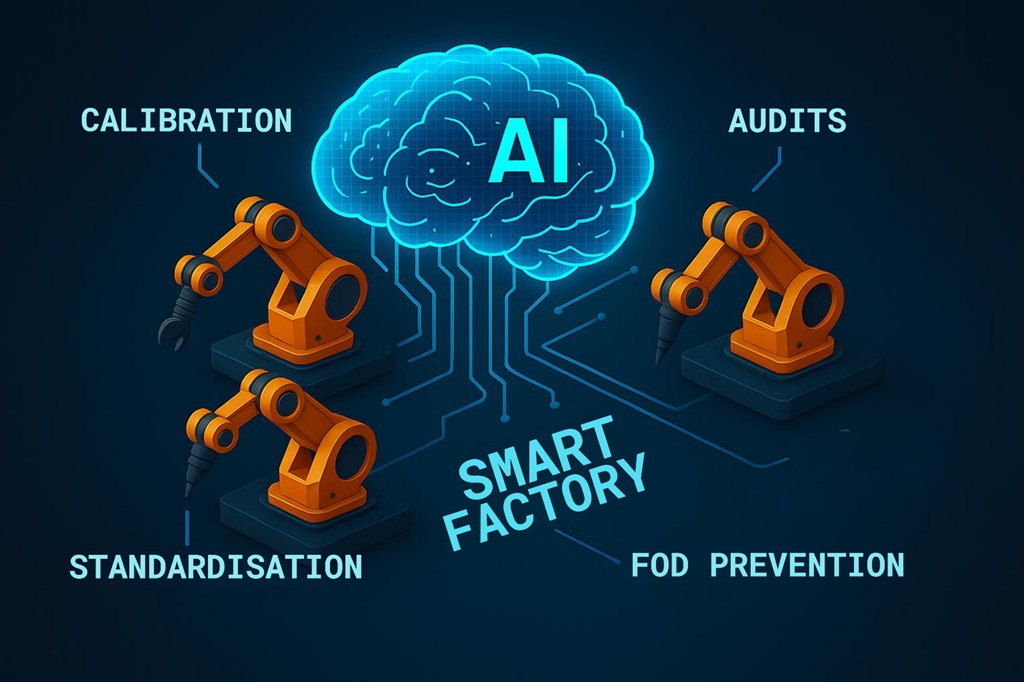
As we move toward “autonomous, smart operations” where AI acts as the plant’s brain, your tools are the limbs. If those limbs are uncalibrated or unorganised, the most advanced AI in the world cannot guarantee safety or efficiency.
If your tools are not correctly looked after, then the robots and machinery they service and maintain or the products they build will suffer and the knock-on effects can be severe and costly.
With 35% of food safety non-conformances already linked to maintenance and calibration gaps, the message for 2026 is clear: Resilience isn’t built in the boardroom; it’s built at the tool level.