Calibration is broken: Why every industry is rethinking tool compliance
Most manufacturers pass their calibration audits. That doesn’t mean their calibration systems actually work.
Because passing an audit isn’t the same as being in control.
Across food production lines, aerospace MRO bays, automotive plants, and defence facilities, calibration is still treated as a periodic checkbox exercise. Tools are calibrated, certificates are stored, spreadsheets are updated, and when the auditor arrives, everything looks fine.
But step onto the shop floor, and a different picture often emerges:
- Tools that are technically “in calibration”, but not verified in context
- Records that exist, but aren’t trusted
- Schedules that are followed, but don’t reflect real-world usage
The uncomfortable truth is this: calibration isn’t failing because of poor intent. It’s failing because the system it relies on hasn’t evolved.
The problem isn’t calibration. It’s how we manage it.
 For decades, calibration has followed the same model:
- Fixed intervals (every 3, 6, or 12 months)
- Manual tracking via spreadsheets or disconnected systems
- Reactive workflows driven by audits rather than operations
That worked when manufacturing was simpler, slower, and less connected. But today, production environments are fundamentally different:
- Tools feed data directly into quality decisions
- Systems are expected to be digitally traceable
- Audits demand end-to-end visibility, not just documentation
And yet, many calibration processes are still running on legacy assumptions.
Compliance hasn’t got harder. It’s just more honest.
Regulations across industries are tightening, but not arbitrarily.
- Food manufacturing audits increasingly expose documentation and traceability gaps, not just hygiene issues
- Aerospace standards demand higher levels of traceability and calibration control across assets
- ISO frameworks are shifting toward data integrity and digital traceability at system level
What’s changed is simple: auditors are no longer just checking if records exist; they’re checking if they can be trusted.
This is where traditional calibration systems start to break down.
The gap between “in calibration” and “in control”.
A tool marked as “in calibration” creates a false sense of certainty.
Because that label doesn’t tell you:
- Whether the tool has drifted since its last check
- Whether it’s being used outside its intended conditions
- Whether the data it produces is still reliable
In high-precision environments, even small deviations have a measurable impact.
- Minor calibration issues can delay aerospace operations and trigger rework
- Slight inaccuracies in manufacturing can lead to scrap, yield loss, or compliance risk
The risk isn’t obvious failure. It’s silent inaccuracy.
Calibration was designed for a different era.
Traditional calibration models are built around time-based scheduling:
- “Calibrate every 6 months”
- “Check annually”
But this ignores how tools are actually used. Some tools operate continuously under heavy load. Others are rarely used. Treating them the same doesn’t improve compliance; it just creates unnecessary work in some areas, and risk in others.
That’s why leading organisations are moving toward:
- Risk-based calibration
- Usage-driven schedules
- Drift detection and predictive alerts
Calibration is shifting from a calendar event to a continuous signal.
The rise of the connected tool.
At the same time, the tools themselves are changing. Across industries, we’re seeing rapid adoption of:
- RFID and RTLS for real-time tool tracking
- IoT-enabled instruments streaming performance data
- Integrated systems connecting tools to quality and production workflows
This changes the role of calibration entirely. Tools are no longer static assets. They are live data sources.
And once tools start generating data that drives decisions, calibration becomes more than a compliance task.
It becomes a data integrity problem.
The real bottleneck: fragmentation.
Most calibration failures don’t come from bad engineering. They come from disconnected systems:
- Calibration records stored in one place or multiple scattered locations
- Tool tracking handled somewhere else or not at all
- Audit evidence assembled manually under pressure
In many organisations, there’s no single view of what tools exist, where they are, their calibration status and their audit history.
Without that visibility, teams rely on manual processes, workarounds and frantic last-minute audit preparation. And that’s where things break.
What “Good” looks like now.
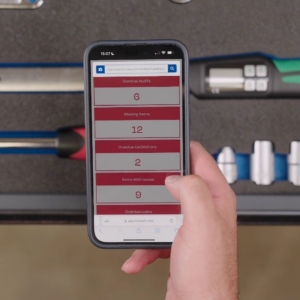 Forward-looking manufacturers aren’t abandoning calibration. They’re rebuilding it around visibility and control. That means:
- Centralised systems where tools, calibration, and audits connect
- Real-time tracking so tool status is always visible
- Automated alerts instead of manual reminders
- Digital audit trails that don’t need to be reconstructed
The goal isn’t just to pass audits. It’s to ensure that at any moment, you can answer three simple questions:
- What tools do we have?
- Are they fit for use right now?
- Can we prove it instantly?
Calibration isn’t broken. But the way we think about it is.
Calibration was once a back-office function. Today, it sits at the intersection of Quality, Operations, Compliance and Data / Business Intelligence. And that changes the expectations entirely.
The companies that are getting ahead aren’t asking “Are we compliant?”, they’re asking “Do we have control?” Because in modern manufacturing, compliance is just the outcome. Control is the advantage.
Final thought.
If your calibration process still depends on static schedules, manual records and disconnected systems, it’s not future-proof. It’s fragile…and it will leave you exposed. And in an environment where precision, traceability, and auditability are non-negotiable, that fragility quickly becomes risk.